I'm Antonio, an experimental physicist interested in the theory behind what we observe. I combine optical experiments, established physical models and computational methods to explore the microscopic world. Trapping particles with light, making sense of randomness, and occasionally convincing computers to cooperate — currently at the University of Gothenburg.
A personal corner of the internet for experiments, ideas, and the occasional unexpected result. ↗
FROM MY LAB NOTEBOOKOPTICAL TRAPPING
FIG. 01 — A PARTICLE AT THE OPTICAL FOCUSλ / 1064 nm · illustrative
01 / ABOUT
A little about me.
✳ From Naples to Gothenburg, following questions about motion, light and matter.
I am an experimental physicist based in Gothenburg, Sweden. I enjoy exploring physical phenomena from both theoretical and experimental perspectives: understanding the physics behind what I observe, using established models to interpret results, and designing experiments to test ideas.
My path started in Naples, where I earned a PhD in Physics at the University of Naples Federico II, and continued to the University of Gothenburg. Along the way, I have worked on unusual diffusion, optical speckle fields, intracavity trapping and machine-learning-assisted optical tweezers. I am especially interested in deepening the connection between theory and experiment, with the goal of developing physical models of my own.
Sometimes things don't behave as expected. That's usually when it gets interesting.
Connecting experiments with statistical-physics models and computational approaches.
Optical Manipulation
Optical tweezers, intracavity feedback trapping, and precise control of microscopic particles, guided by physical models of light–matter interactions.
Optical tweezersFeedback trapping
Soft Matter & Stochastic Dynamics
Experiments, numerical simulations and theoretical interpretation of stochastic motion, including Fickian yet non-Gaussian diffusion in structured optical fields.
Statistical physicsStochastic models
Machine Learning for Experiments
Data-driven and computational approaches to optical trapping, particle tracking, calibration and automated precision experiments.
Deep learningAutomation
03 / PROJECTS
From idea to experiment.
A closer look at some of the questions, methods and collaborations behind my work.
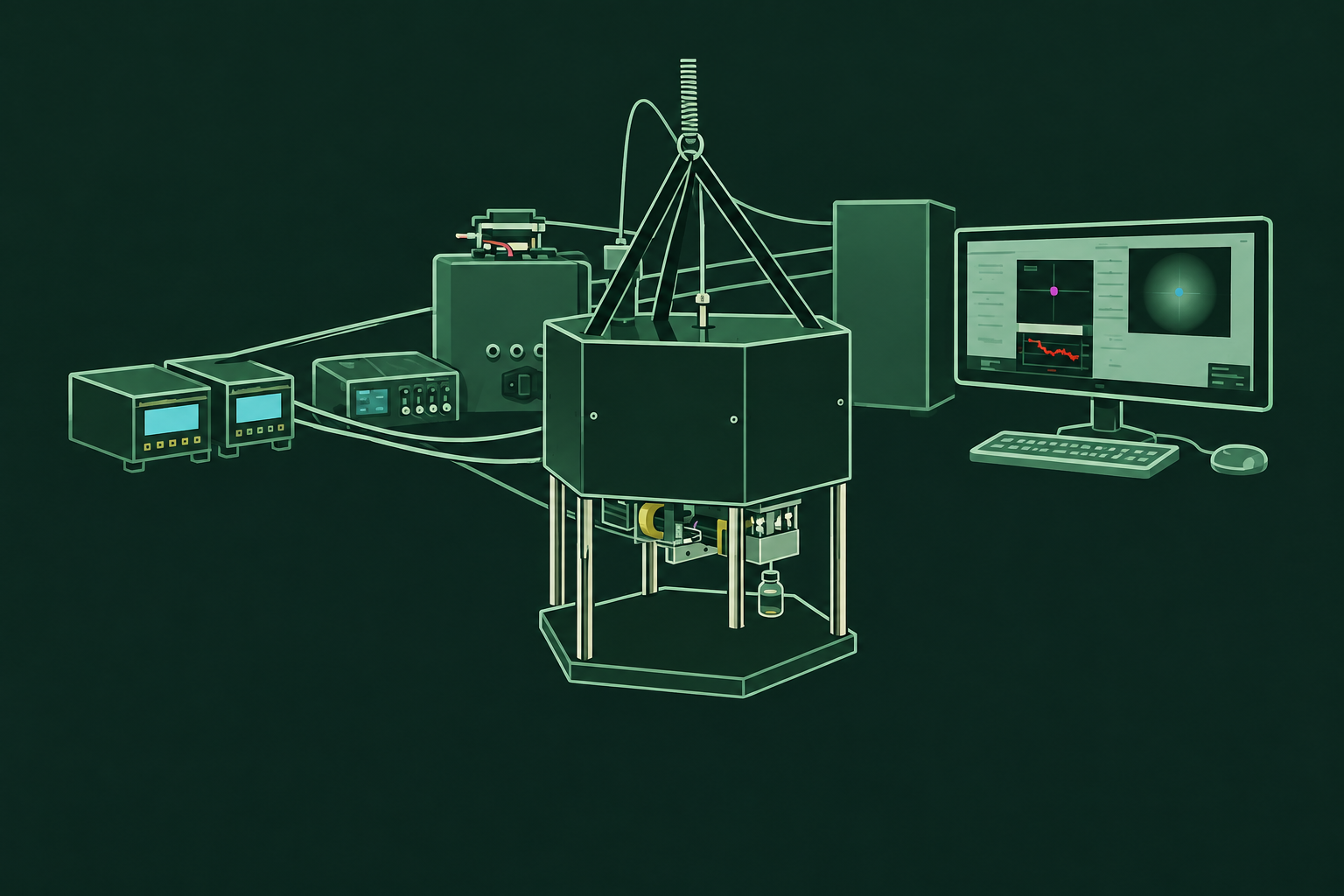
PRECISION EXPERIMENTSSmartTrap · An illustrated view of the experimental setup, based on the apparatus photograph (schematic, not to scale).
SmartTrap
Precision experiments with optical tweezers involve more than holding a particle in place. SmartTrap explores how automation can help make measurements more reproducible and experimental workflows more flexible.
The project brings together optical manipulation, computational tools and experimental design, developed in collaboration with colleagues.
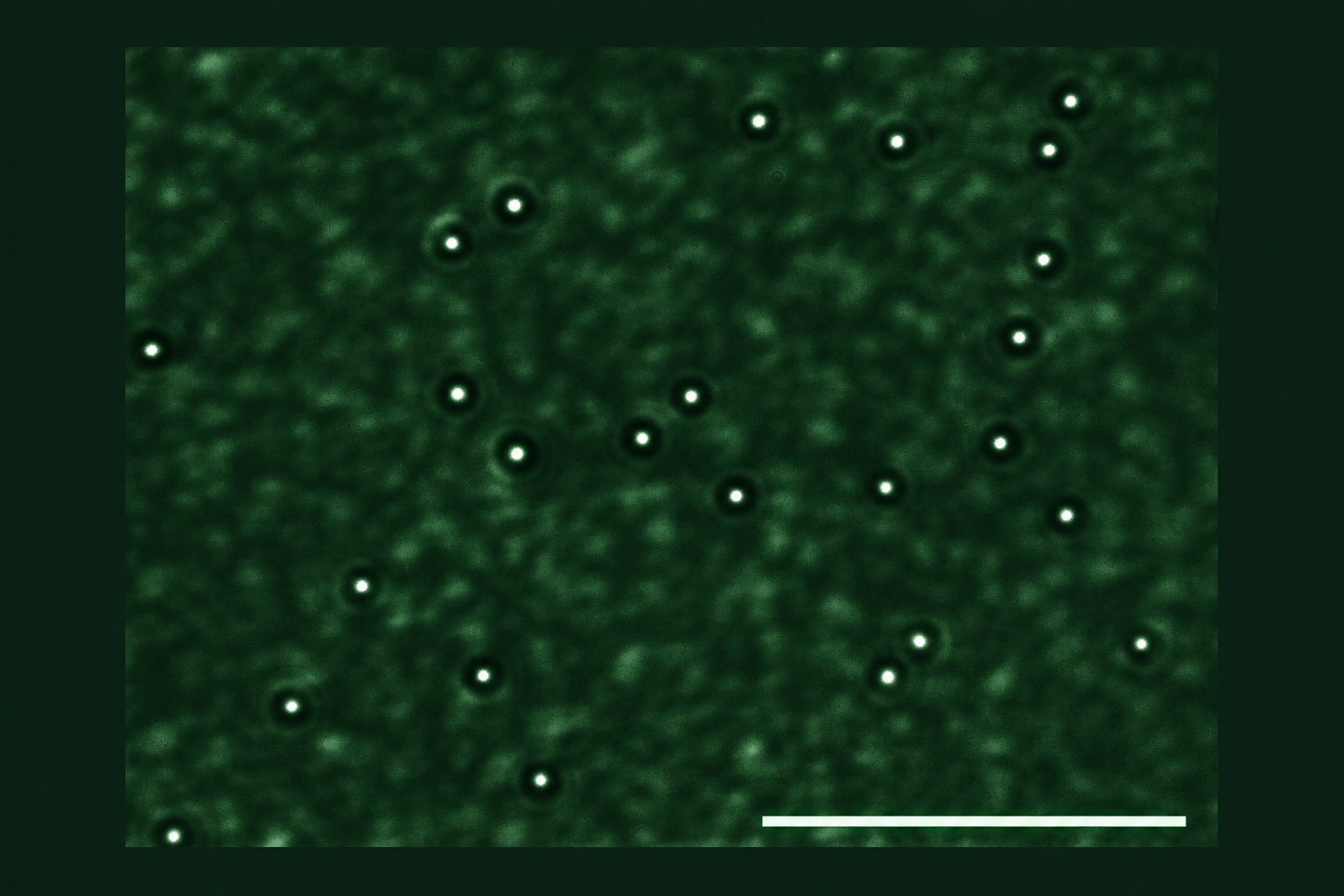
SOFT MATTER · STOCHASTIC DYNAMICSGreen-toned reinterpretation of microscopy panel A (illustrative, not experimental data).
Diffusion in optical speckle fields
What happens when microscopic particles move through a disordered landscape of light? Optical speckle fields provide a way to explore how complex environments affect diffusion.
By combining experiments, numerical simulations and established stochastic models, this work investigates how apparently ordinary diffusion can coexist with non-Gaussian displacement statistics.